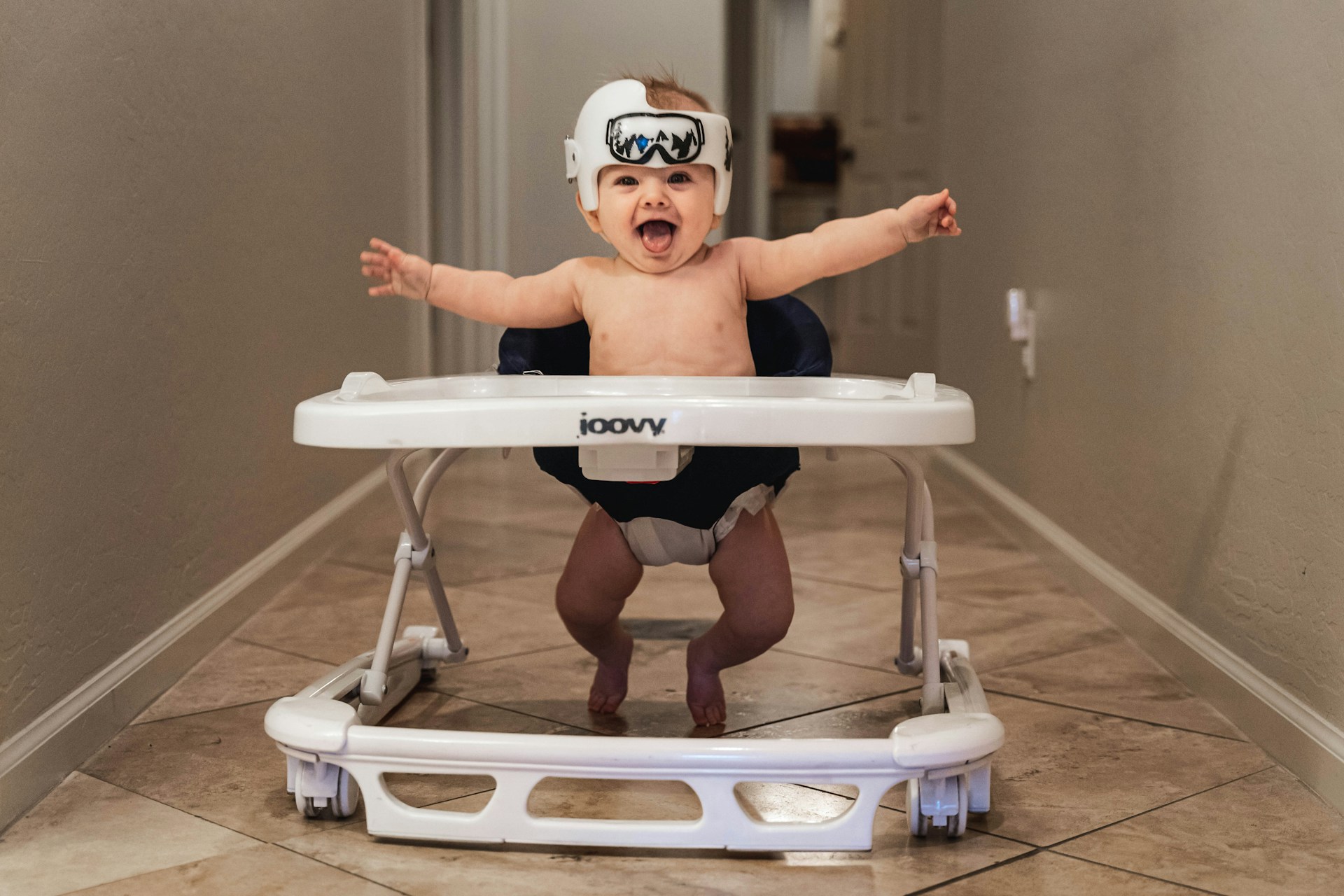
If your baby has a flat spot on the back or side of their head, one of the first things you'll come across is helmet therapy.
It's widely discussed in parenting forums and often presented as the main treatment option. But for many babies, a helmet isn't the only way forward, and it may not be necessary at all.
Flat head syndrome, known medically as positional plagiocephaly, is more common than many parents realise. Research suggests it affects somewhere between 20% and 47% of healthy infants in the first few months of life, largely because of the (entirely correct) recommendation to place babies on their backs to sleep.
The reassuring part is that it responds well to early, consistent, non-invasive approaches. In a large study of over 4,300 infants, around 77% achieved complete correction through conservative treatment alone, without a helmet. Of those who didn't fully respond to repositioning, the vast majority went on to correct fully with additional support. The earlier these approaches are introduced, the more effective they tend to be, because a baby's skull is still soft and naturally responsive to changes in position and movement during the first months of life.
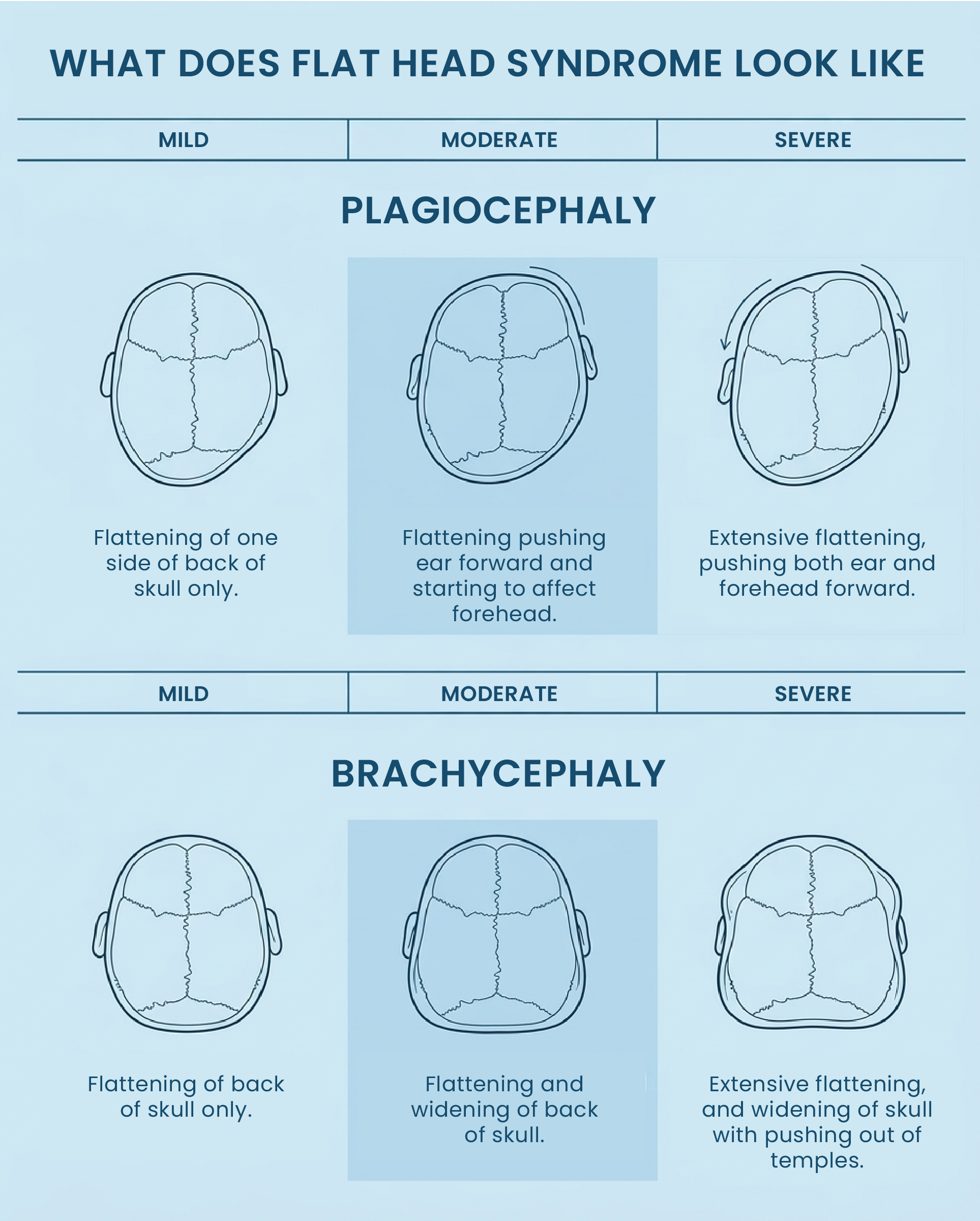
What causes flat head syndrome?
A baby's skull is made up of separate bones that haven't yet fused together. This is what allows the head to pass through the birth canal and gives the brain room to grow rapidly in the first year.
Because the bones are soft and flexible, they're also responsive to pressure. When a baby spends extended time with the same part of their head resting against a surface, that area can gradually flatten.
Several things can contribute to this:
- Back sleeping. Placing babies on their backs to sleep is important for reducing the risk of SIDS, and that guidance hasn't changed. But it does mean more sustained pressure on the back of the skull compared to previous generations.
- Limited head turning. Some babies develop a preference for turning their head to one side. This can concentrate pressure on a single area rather than distributing it evenly.
- Neck tightness or torticollis. When the muscles on one side of the neck are tighter than the other, it can make it harder for a baby to turn their head freely. This often goes hand in hand with flat head development.
- Time in “containers”. Prams, car seats, bouncers and swings are practical and sometimes essential, but they all involve the baby resting their head against a firm surface. Extended use throughout the day adds up.
Can flat head correct itself without a helmet?
A helmet works by leaving space where the head is flat and applying gentle contact where it's round, encouraging growth into a more symmetrical shape. It's effective for moderate to severe cases, particularly when introduced during the right window (typically between four and eight months).
But the same principle, encouraging the head to grow more evenly, can also be supported through other means. A systematic review of conservative treatments found that hands-on manual therapy produced the best results among non-helmet approaches, particularly when combined with repositioning guidance for parents. These approaches work best when started early, ideally in the first few months, while the skull is at its most responsive.
How do I reposition my baby to improve head shape?
This is the foundation of non-helmet management.
The goal is to reduce the amount of time your baby spends with the flat area of their head pressing against the mattress, without changing the back-sleeping position itself.
- Alternate the direction your baby faces in the cot. Babies tend to turn towards light, sound or activity. Changing which end of the cot their head is at can encourage them to look in a different direction.
- Move the cot or changing table so that interesting things (a window, a doorway, your voice) come from the side your baby tends not to look towards.
- During supervised rest and naps where you're present, gently reposition the head if your baby consistently turns to one side.
Small, consistent changes in positioning tend to be more effective than occasional big adjustments.
Does tummy time help with flat head syndrome?
Tummy time serves two purposes for flat head management.
1) it takes all pressure off the back of the skull.
2) it strengthens the neck and shoulder muscles your baby needs to control their own head position.
If your baby resists tummy time, which is common, try:
- Starting with short periods (one to two minutes) several times a day rather than longer sessions
- Lying on your back and placing your baby on your chest, so they can see your face
- Using a rolled towel under the chest for a slight lift, which can make the position more comfortable
- Getting down on the floor at their level so they have something engaging to look at
The goal is frequency and consistency rather than duration. A few minutes multiple times a day is more helpful than one longer session.
How does carrying position affect head shape?
Every moment your baby is upright and off a flat surface is time the skull isn't under positional pressure.
- Hold your baby upright against your shoulder when carrying them around the house.
- Vary the arm you carry them in, which also encourages them to look in different directions.
- Limit time in car seats and bouncers to when they're genuinely needed (travel, safety), rather than as a default resting position at home.
How can I encourage my baby to turn their head both ways?
If your baby favours one side, you can encourage them to turn the other way during everyday interactions.
- Offer toys, your face, or interesting sounds from the less-favoured side.
- During feeding, alternate which side you hold them on where possible. If breastfeeding, this happens naturally. If bottle feeding, consciously switch arms between feeds.
- During play, position yourself on the side your baby turns towards less often.
The aim is gentle encouragement, not forcing. Babies respond to interesting things happening around them, and small, consistent prompts tend to work better than persistent repositioning.
These repositioning and carrying strategies work well alongside a broader understanding of your baby's development in these early months. Our free guide covers this in more depth, including how flat head syndrome and torticollis often show up together.
When should I consider an osteopathic assessment for flat head syndrome?

The approaches above are things parents can do at home, and they're often very effective. But there are situations where a baby's head-turning preference has a physical component that repositioning alone may not fully address.
This is where an osteopathic assessment can be helpful.
An osteopath trained in paediatric care will assess how freely your baby moves their head and neck.
They're looking at whether the preference for turning one way is simply a habit, or whether there's underlying tension or restriction that's making it harder for the baby to turn in both directions equally.
This matters because when a baby can't turn their head freely, the repositioning strategies above become less effective. The baby keeps returning to the same position, not because they prefer it, but because their neck doesn't move as easily the other way.
Gentle osteopathic techniques can help address restrictions in the neck, shoulders, and upper body.
Treatment is very light, appropriate for a newborn's developing body, and often combined with specific guidance for parents on positioning and tummy time that's tailored to their baby's particular pattern.
At City Osteopathy, our principle practitioner Benjamin Lai is the only osteopath in Hong Kong with Advanced Paediatric Osteopathy qualifications from Australia, and an alumnus of London's Osteopathic Centre for Children. Our Happy Melons Program is designed specifically for early assessment and monitoring of head shape, neck movement and postural patterns in babies.
When should I worry about my baby's head shape?
Most cases of positional plagiocephaly are mild and respond well to the approaches described above.
It's worth seeking an assessment if:
- Your baby strongly favours one side and resists turning the other way
- You've been repositioning consistently for several weeks without noticeable change
- The flat spot appears to be getting more pronounced rather than improving
- Your baby also shows signs of neck tightness or torticollis
- You'd like an objective measurement of head shape to track progress over time
An assessment doesn't commit you to any particular course of treatment. It gives you a clear picture of what's happening and whether additional support could help.
Why is my neck so stiff since having my baby?
Flat head concerns often surface during a stage of parenthood that's already physically and emotionally demanding. You're likely spending a lot of your day looking down at your baby, getting on and off the floor for tummy time, carrying them in ways that encourage head turning, and monitoring their progress closely.
That's a lot of sustained loading on your own neck and upper body, especially when it's repeated day after day alongside everything else.
If you're noticing your own neck feeling stiff or tight during this period, that's common. The postures involved in repositioning, supervised tummy time and careful monitoring all tend to concentrate strain through the neck and upper back. It may be worth having that looked at rather than waiting for it to settle on its own, particularly when the physical demands of this stage can continue for several months.
Getting Started
If you're unsure whether your baby's head shape needs attention, schedule an appointment below.
The first six months are when the skull is most responsive to changes in positioning and movement patterns. Starting early, even if the flat spot is mild, gives you the widest range of options and the best opportunity for improvement without more intensive intervention later.