
Their baby always seems to look the same way when lying down, or settles more easily on one side during feeds.
It might not seem like much at first, particularly with a newborn who's still developing head control.
But if your baby consistently favours turning or tilting their head in one direction, it may be worth taking a closer look. That pattern can sometimes indicate torticollis, a condition involving tightness in the neck muscles that limits how easily a baby turns their head.
Torticollis is common, not harmful in itself, and responds very well to early attention. Research shows that the vast majority of cases, around 90 to 95%, resolve with conservative care such as gentle manual therapy, positioning guidance, and exercises. Knowing what to look for can help you seek guidance at the stage when it's easiest to address.
What is infant torticollis?
Torticollis means "wry neck." In infants, it typically refers to a tightness or shortening of the sternocleidomastoid muscle, which runs along each side of the neck from behind the ear to the collarbone.
When this muscle is tighter on one side, it can pull the baby's head into a tilted or rotated position. The baby may tilt their head towards the tight side and turn their face away from it.
There are two broad types:
Congenital muscular torticollis is present at or shortly after birth. It may be related to positioning in the womb, a difficult delivery, or the birth process itself. In some cases, a small, firm lump can be felt in the affected muscle during the early weeks, though this isn't always present and usually resolves.
Acquired or positional torticollis develops after birth, often during the first few months. It can result from a baby spending extended time with their head turned one way, which gradually creates a preference that reinforces itself.
Both types are manageable, and both benefit from early recognition.
What are the signs of torticollis in a baby?
The signs can be subtle, particularly in the early weeks when babies are still developing head control. Parents often notice the pattern gradually rather than all at once.
Things to look for include:
- Head tilt. Your baby's head consistently leans to one side, even when they're alert and upright. One ear may sit noticeably closer to the shoulder on that side.
- Turning preference. Your baby strongly favours looking in one direction when lying on their back. They may resist or become unsettled when you gently encourage them to look the other way.
- Feeding issues. Feeding may feel easier or more comfortable on one side than the other. Your baby might latch well when facing one direction but struggle or pull away when switched. Shallow latch can also be another sign.
- Asymmetry in movement. You might notice that your baby reaches or bats at objects more on one side, or that one arm seems more active than the other during play.
- A developing flat spot. Because the baby consistently rests on the same part of their head, a flat area can develop on the back or side of the skull. This is positional plagiocephaly, and it often occurs alongside torticollis.
- Discomfort during tummy time. Some babies with torticollis find tummy time particularly frustrating, because the position asks them to use their neck in ways that feel more difficult on one side.
No single sign confirms torticollis on its own. But if you're noticing a consistent pattern across several of these, it's worth having your baby assessed.
Can torticollis affect my baby's development?
Torticollis itself is not dangerous, and many mild cases improve naturally as babies grow, gain strength and begin to move more. But when it persists, it can influence other areas of development.
A baby who can't turn their head freely may:
- Develop an uneven head shape from sustained pressure on one side
- Have difficulty with feeding comfort and positioning
- Show a preference for using one side of their body more than the other as they grow
- Find certain developmental milestones, like rolling or sitting evenly, more challenging
Early attention tends to produce the best outcomes because the neck muscles and skull are most responsive during the first months of life. The timing difference can be significant.
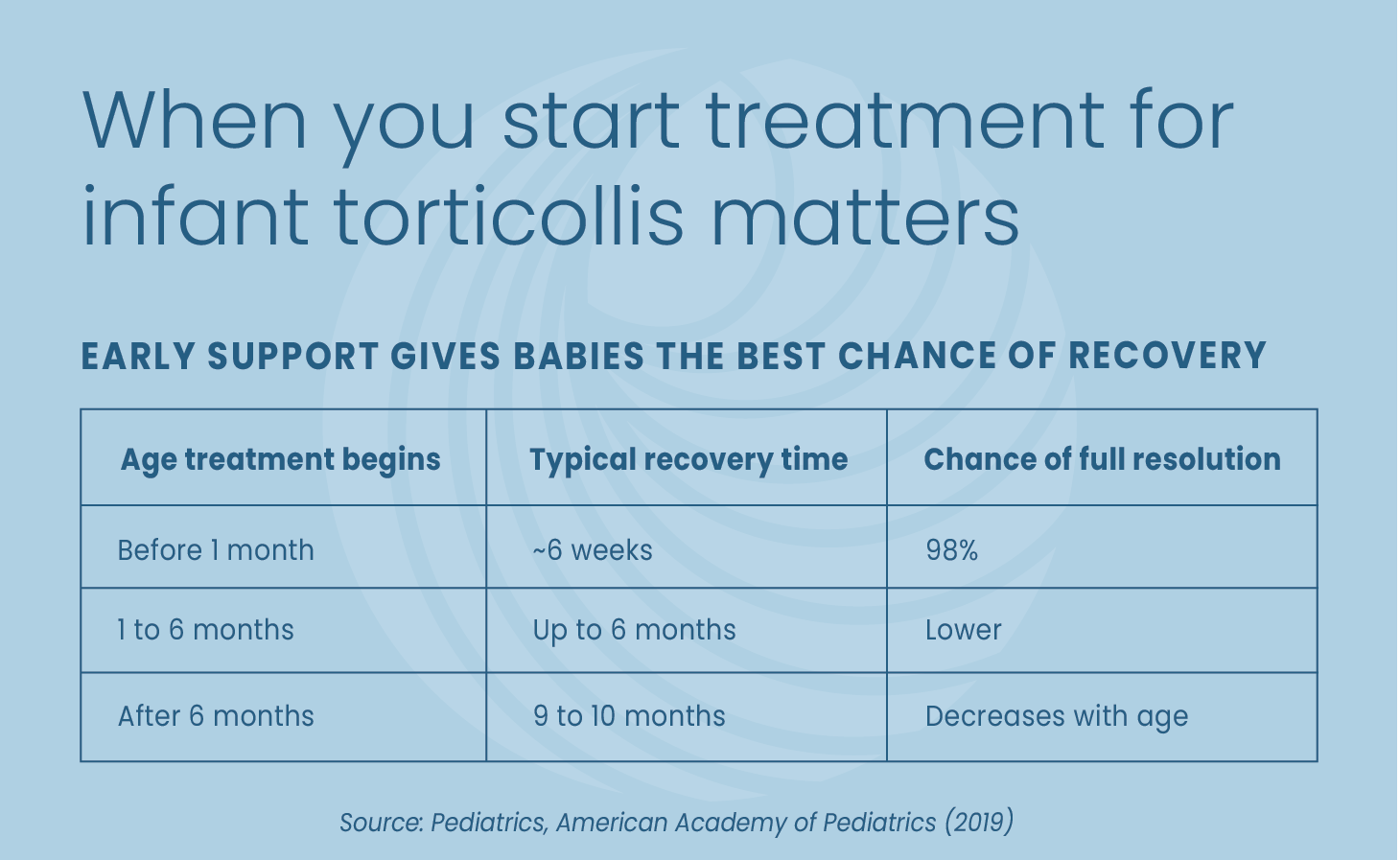
Research from the Children's Hospital of Philadelphia found that babies who begin treatment before one month of age have up to a 98% chance of achieving full range of neck movement within around six weeks. Babies who start between one and six months typically need around six months of support. After six months, treatment can take closer to nine months and full resolution becomes less certain.
This doesn't mean it's too late if your baby is older. It simply means that earlier is easier, for both baby and parent.
What happens at a torticollis assessment?
An osteopathic assessment for torticollis is gentle and non-invasive. It's designed to understand how your baby's neck, head and body are moving, not just to confirm whether torticollis is present.
During an assessment, we look at:
- Range of movement. How freely does your baby turn their head in both directions? Is there a clear difference between left and right?
- Muscle tone and tension. Is there noticeable tightness on one side of the neck? Are the shoulders and upper body also involved?
- Head shape. Has the turning preference already started to affect the shape of the skull?
- Whole-body patterns. Neck preference is part of a broader postural pattern involving the shoulders, spine, or pelvis. Babies don't move in isolated segments, so we assess how the whole body is organising itself.
- Feeding and positioning. We often observe how the baby positions during feeding, as this can provide useful information about where restrictions may be affecting comfort.
The assessment gives parents a clear picture of what's happening and whether support would be helpful.
How is infant torticollis treated?
Osteopathic treatment for infant torticollis uses very gentle techniques suited to a baby's developing body. The aim is to help release tension in the affected muscles and support more balanced neck movement.
This typically involves:
- Gentle hands-on work to address tightness in the neck, shoulders and surrounding areas. The pressure used is very light, often no more than the weight of a coin.
- Guidance on positioning and handling that parents can use at home. This includes specific ways of holding, carrying and encouraging head turning that support what's being addressed in treatment.
- Tummy time strategies tailored to your baby's particular pattern of restriction, making the position more comfortable and productive.
- Monitoring progress over time, with regular reassessment of neck movement, head shape and developmental milestones.
Treatment is not a single event. It usually involves a series of sessions, combined with consistent home strategies, to gradually improve range of movement and support more symmetrical patterns as the baby grows.
At City Osteopathy, our lead practitioner Benjamin Lai is the only Osteopath in Hong Kong with Advanced Paediatric Osteopathy qualifications from Australia, and is an alumnus of London's Osteopathic Centre for Children. Our Happy Melons Program includes assessment of neck movement, head shape and postural patterns, with structured monitoring throughout the early months.
What can I do at home to help my baby's torticollis?
While professional assessment and guidance are valuable, there's a lot parents can do between sessions to support progress.
- Encourage looking both ways during play, feeding and everyday interactions. Position interesting things (your face, toys, sounds) on the less-favoured side.
- Vary how you carry your baby. Alternate arms, use upright carrying positions, and be conscious of which side your baby tends to rest against.
- Make tummy time regular and short. Frequency matters more than duration. Several brief sessions throughout the day help build strength and tolerance gradually.
- Be mindful of "container" time. Prams, car seats, bouncers and swings all involve the head resting against a surface. Use them when needed, but try to balance them with upright holding and floor time.
- Be patient with the less-favoured side. If your baby resists turning one way, gentle, consistent encouragement works better than forcing. It takes time for the muscles to lengthen and for the new pattern to feel natural to them.
Why do my shoulders ache from carrying my baby?
If your baby has been given stretching or positioning exercises, you'll know how physically involved this stage can be. Holding a wriggling baby in specific positions, supporting their head and neck during exercises, getting on and off the floor for tummy time practice, often several times a day, all of this loads your own body in ways that build up over weeks and months.
Parents managing a baby's torticollis often notice increasing tightness in their own shoulders and upper back. The sustained arm positions involved in stretching and holding exercises, combined with the one-sided carrying that naturally happens during this stage, tend to concentrate strain through the shoulders and upper body.
If you're finding that your own shoulders or upper back are becoming uncomfortable, it's worth addressing that alongside your baby's care. These patterns tend to build gradually and don't always resolve on their own, particularly when the physical demands continue over several months.
When should I get my baby checked for torticollis?
Many babies show mild position preferences in the early weeks that improve on their own. However, it's worth seeking professional assessment if:
- Your baby consistently tilts or turns their head to one side and resists the other direction
- The preference doesn't seem to be improving with repositioning at home
- Feeding is consistently easier on one side than the other
- You're noticing a flat spot developing on the back or side of the head
- Your baby seems uncomfortable or frustrated during tummy time beyond what you'd expect
- You'd simply like an expert to take a look and advise on whether anything needs attention
- Your baby’s latch is shallow and painful
- Your baby's head control seemed surprisingly strong from birth
An early assessment doesn't mean something is wrong. It means you're giving your baby the best chance of balanced, comfortable movement as they grow.