Free download
Everyday Newborn Care: Feeding Basics
The same booklet we give new parents at the clinic, in your inbox.
You'll also join our mailing list: a monthly note from the clinic on looking after your body, and your family's. Unsubscribe anytime.
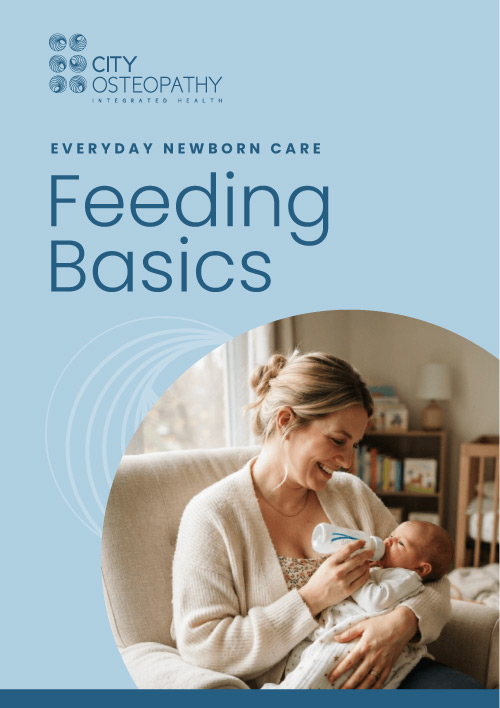
Whether you breastfeed, formula feed or combine both, what matters most is a fed, thriving baby. There's no single right way, and the early weeks are mostly about learning your baby's cues and finding a rhythm together.
This page covers what we tell new parents in clinic every week: how often to expect feeds, the signs that baby is hungry or full, how to burp properly, and the small number of feeding patterns that are worth having checked.
How often should a newborn feed?
Most newborns feed 8 to 12 times a day in the first few weeks. That frequency is normal, not a sign that anything is wrong or that baby isn't getting enough.
Feeds are short and close together because a newborn's stomach is small and breast milk and formula are digested quickly. Expect the gaps to lengthen gradually over the first couple of months rather than settle into a schedule straight away.
What are the signs my newborn is hungry?
The earliest hunger cues are rooting (turning the head and opening the mouth towards touch), bringing hands to the mouth, sucking motions, and a shift towards restlessness or alertness. Crying is a late cue.
Catching the earlier signs matters because a baby who is already crying is harder to latch and harder to settle. If you can start the feed while baby is still rooting, it tends to go more smoothly for both of you.
How do I know when my baby is full?
A full baby slows or stops sucking, turns away from the breast or bottle, relaxes through the hands and body, and often falls asleep. Those are the signs to stop rather than encourage another few minutes.
How do I burp a newborn properly?
Hold baby upright against your shoulder, or seated on your lap leaning slightly forward, and pat firmly on the back at the level of the abdomen, just below the rib cage. That's where trapped air tends to sit, and patting there rather than higher up is more effective at helping it rise.
Burping is easy to treat as an afterthought. It isn't one. A newborn's gut is still immature, and air left unresolved can mean discomfort, spit-up and a harder time settling. Make it a habit each time you pick baby up, not only after a full feed, and give it at least five minutes, even after the first burp you hear.
Is cluster feeding normal?
Yes. Cluster feeding, a run of frequent short feeds, often in the evening, is common in the early weeks and usually passes. Reflux-like spit-up after feeds and some latch discomfort in the first days are also common and tend to resolve with time and small changes to positioning.
Persistent pain during feeds, or poor weight gain, is different. Both are worth raising with your midwife, paediatrician or GP rather than waiting out.
When do feeding difficulties point to something more?
Latching and sucking rely on smooth coordination between the head, neck and jaw. When that coordination is disrupted, feeding is often the first place it shows.
The pattern we'd suggest watching for: baby consistently arches during feeds, resists being tucked into a curled position, or seems unusually strong or stiff through the neck. Alongside that, you might notice a shallow latch, clicking sounds while feeding, milk leaking from the mouth, or tiring quickly at the breast or bottle.
Any one of these on its own is usually nothing. Together, they can sometimes reflect musculoskeletal tension in the neck or upper spine that affects feeding mechanics, and that is something a neonatal assessment can look at directly.
How can City Osteopathy Integrated Health help with newborn feeding difficulties?
Our neonatal assessment looks at how your baby's head, neck and jaw are working together, alongside their posture, movement and comfort when held and fed. Ben, our Principal Osteopath, leads these appointments.
The point of the assessment is a clear answer. Either the tension is there and we can talk through gentle, appropriate treatment, or it isn't and you can stop wondering. Many parents come to us having noticed something at feeds for a while without knowing whether it warranted a visit. It's a reasonable thing to want settled.
When should I see someone about my newborn's feeding?
If you've been wondering for a while now whether your baby's arching, stiffness or difficulty latching is more than early-days adjustment, an assessment is the direct way to find out.
Book an appointment below or request a callback, and we'll take it from there.