Most of the tension we carry doesn't arrive suddenly. It builds — through the way we sit, breathe, carry, and move (or don't) over months and years. This A–Z is a guide to where that tension tends to show up, why it happens, and what may help.
A – Achilles: Why It Tightens From Sitting and Unsupportive Shoes
Your Achilles works hard every day. Most people don't notice it. Prolonged sitting and unsupportive shoewear shorten the calf and strain the Achilles over time. By the time it feels tight or tender, the pattern has usually been building for months. Our assessment looks at the whole chain from the foot upward, identifies where tension is coming from, and works out what needs to change to reduce the strain.
B — Breathing: Are You Breathing as Deeply as You Think?
On average, adults take about 20,000 to 22,000 breaths per day. How deep and full are yours? Most people breathe only into the top third of their lungs. Short, shallow breaths stresses the nervous system and affect posture, tension, and how well the body recovers. Osteopathic treatment looks at what's restricting full breath – ribcage mobility, thoracic tension, and the way the body has learned to hold itself – and works to restore the movement that makes deep, easy breathing possible again.
C — Carrying: What the Same Bag on the Same Shoulder Does Over Time
Same bag, same shoulder, every day. Asymmetry isn't a problem in the short term. Repeated daily for months or years, it becomes the reason one side of your back is always tighter, one shoulder always higher, one hip always slightly off. Our clinical massage works into the overloaded side, releasing the muscles that have been carrying more than their share and restoring balance to tissue that's been under sustained, uneven load.
D — Desk: How Your Body Adapts to Eight Hours in a Chair
No desk is designed to be sat at for eight hours. Your body knows this. Shoulders creep forward. The lower back rounds. The neck moves toward the screen. These aren't bad habits – they're your body solving a problem in the moment. The issue is when those solutions become permanent. Our osteopathic assessment identifies where those adaptations have taken hold, what they're affecting, and what needs to change.
E — Eyes: The Screen Tension You Don't Notice
Most people frown at their screen without realising it. Squinting, tensing the forehead, holding the face fixed in concentration – it's a habit that builds through the day without any conscious awareness. That tension isn’t just in the face. It is also in the jaw, the neck, and the shoulders. We clench. One of the simplest things you can do is look away from your screen regularly, let your eyes soften, and allow your face to fully relax. Our osteopathic assessment looks at where that accumulated facial and neck tension has taken hold and help you resolve them.
F — Fascia: Why Pain Rarely Stays Where It Starts
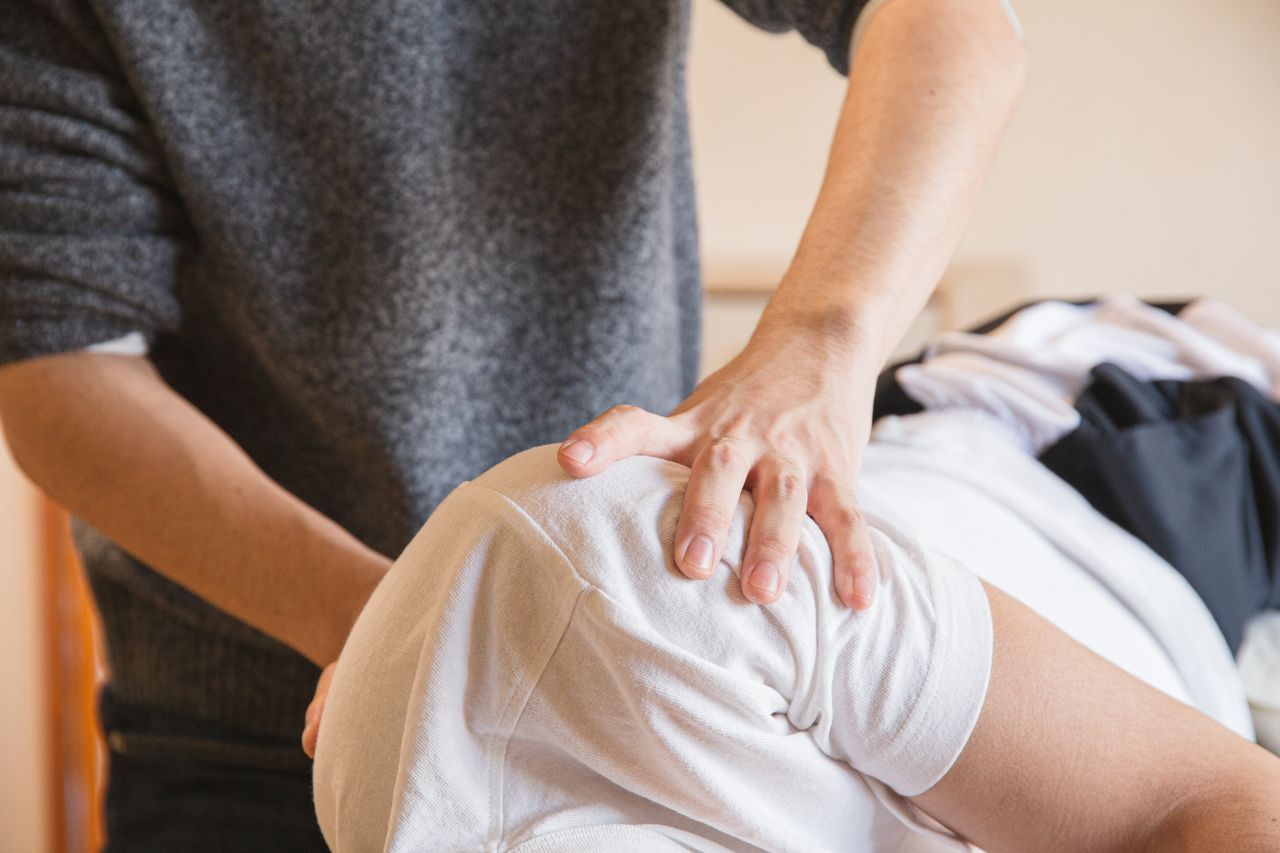
Fascia is the connective tissue running continuously through your entire body, wrapping muscles, joints, and organs in one uninterrupted web. When tension builds in one area, it pulls on adjacent structures and shifts load elsewhere, which is why a tight hip can show up as lower back pain, or shoulder restriction can contribute to neck stiffness. As experts in fascia, our osteopathic assessment looks at the full picture rather than treating the site of pain in isolation.
G — Gut: How Stress Shows Up in Your Digestion
Stress doesn't just live in your head. The gut and nervous system are in constant communication. Under sustained stress, the body holds tension physically, and a significant amount of that sits in the abdomen. Digestive discomfort, bloating, and that low-level tightness around the middle are often as much a physical response as anything else. Taking time to slow down, check in with how the body is feeling, and consciously release held tension can make a real difference – small moments of awareness throughout the day add up.
H — Hips: How Sitting Restricts Hip Movement
The hips are designed to move in multiple directions. Sitting holds them in one. Over time, the surrounding muscles shorten, the pelvis tilts, and the lower back starts compensating for what the hips can no longer do. For parents, carrying a child repeatedly on one side adds an asymmetric load on top of that. Pilates is particularly effective here, rebuilding hip strength and movement range in a controlled, progressive way that addresses the root of a lot of lower back pain.
I — Impact: Where Does the Force From Every Step Go?
Every step sends a wave through your body. Walking, running, taking the stairs – every impact travels upward through the feet, ankles, knees, hips, and spine. When everything is moving well, that force distributes evenly. When something isn't, other structures absorb more than they should, and over time that's where problems develop. Our Movement MOT looks at the whole chain and identifies where load is accumulating and why.
J — Jaw: The Place Most People Hold Stress Without Knowing
Most people are clenching their jaw right now and don't realise it. The jaw is one of the places the body tends to hold stress — during a difficult call, a tense commute, an approaching deadline. Most people don't notice until it shows up as headaches, night grinding, ear discomfort, or a jaw that aches in the morning. Because the jaw connects directly to the neck and upper spine, tension here rarely stays localised. Our clinical massage works into the jaw, neck, and shoulder tension that all affect each other.
K — Knees: What That Cracking Sound Actually Means
Knee cracking is rarely a problem in itself, but it's often a signal worth paying attention to. The knees frequently take load that should be shared more evenly with the hips and ankles. Weak or restricted hips, stiff ankles, years of sitting – all of these change how the knee is loaded. Our personalised Pilates program builds the hip and glute strength that takes unnecessary load off the knee and addresses the pattern before it becomes pain.
L — Lower Back: Why It's Rarely Just About the Lower Back
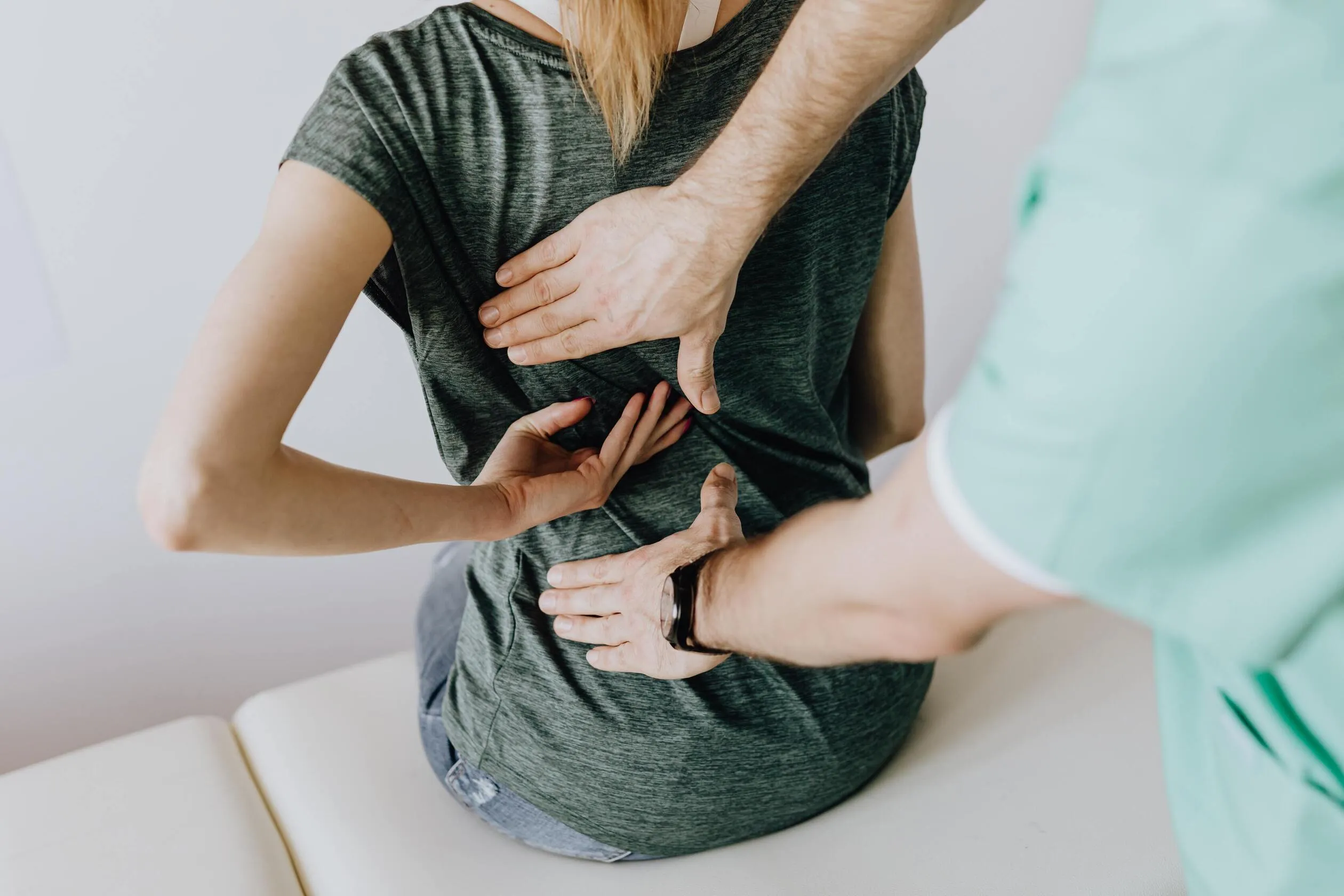
It's the most common complaint and the most misunderstood. Lower back pain is usually a symptom – the source is most often elsewhere: tight hips, a stiff mid-back, strained deep abdominals, or patterns built up over years of sitting. Treating the lower back alone rarely resolves it fully, which is why it keeps returning. Our osteopathic assessment identifies where the problem is actually coming from and treats that rather than the site of pain.
M — Movement: The Four Directions Modern Life Leaves Out
The body is built to move in six directions. Modern life uses about two. Forward and down. That's the range most people operate in day to day – we call this living in 2D. The body is designed to reach, rotate, hinge, and extend in every direction, and when it stops doing those things, joints stiffen, muscles shorten, and the body begins to compensate.
N — Neck: Why It's One of the Most Strained Areas in the Body
The neck is one of the most strained structures in the body. Most people only notice it when it hurts. Seven vertebrae, held upright for most of the day, often tilted forward for hours at a time. The muscles, joints, and surrounding tissue absorb that load continuously. Stiffness, aching, restricted rotation, and persistent soreness that stretching doesn't fully shift are all signs that something in the pattern needs attention. Our assessment looks at the neck in the context of the whole upper body rather than treating it as an isolated problem.
O — Overhead: Why Full Overhead Reach Gets Harder Over Time
Reaching fully overhead requires more of the body than most people realise. Full overhead range needs the shoulder, thoracic spine, and ribcage working together. Most people have lost some of this without knowing it – it goes gradually over years of desk work and limited movement variety.
P — Posture: Why "Good Posture" Isn't a Single Position
Good posture isn't about sitting up straight. It's about having options. The problem isn't any single position – it's staying in one position for too long. A body that can move freely and adjust throughout the day is far healthier than one held rigidly in the "correct" position. What most people think of as bad posture is a body that has run out of options. Our osteopathic assessment looks at what's limiting those options and what needs to change to restore them.
Q — Sleep Quality: Why Waking Up Stiff Isn't a Normal Part of Getting Older
How you sleep, the position you default to, the tension you carry overnight – these reflect what the body is holding during the day. Stiffness in the morning, an aching lower back, a jaw that's been clenched all night are not just sleep issues. Our clinical massage helps the body genuinely decompress, supporting the kind of nervous system regulation that allows tension to release overnight rather than carrying it into the next day.
R — Ribcage: Why Yours Might Feel Stiff
The ribcage expands and rotates with every breath. It moves when you twist, reach, and bend. Or it should. Years of sitting and shallow breathing gradually reduce how much it moves, and when it stiffens, everything around it is affected: breathing becomes more effortful, upper back tension increases, and shoulder mobility suffers. Osteopathic treatment works directly with thoracic and ribcage mobility, one of the most commonly restricted areas and one of the most responsive to treatment.
S — Shoulders: Why They Creep Toward Your Ears
Your shoulders have been creeping upward all day. You probably haven't noticed. Raised, rounded, or locked. The shoulders absorb more daily stress than almost anywhere else in the body. Under pressure, most people brace through the shoulders without realising: a difficult conversation, a tight deadline, a long commute. By the end of the day they're sitting somewhere near the ears. Our clinical massage works into the trapezius, rhomboids, and surrounding tissue that holds the most tension, releasing what's built up and restoring the shoulders to where they should be.
T — Trapezius: The Knot That Won't Shift on Its Own
Your trapezius runs from the base of your skull down to your mid-back and across to your shoulders. Stress raises it. Poor posture loads it. Long hours at a desk keep it contracted. The result is that dense, tender knot that no amount of self-massage quite shifts. Our clinical massage works directly into the trapezius and surrounding tissue, releasing what has built up and restoring circulation to an area that has been under sustained load.
U — Upper Back: Why It Aches Between Your Shoulder Blades
That ache between your shoulder blades is your thoracic spine stiffening from years of sitting rounded at a desk. It's one of the most common places tension accumulates and one of the most stubborn to shift. Most people stretch it, find brief relief, and watch it return within a day. That's because it's usually a symptom of something structural: a stiff thoracic spine, rounded shoulders, a ribcage that has stopped moving freely. Osteopathic treatment addresses thoracic mobility directly rather than managing the surface tension.
V — Vertigo: Could It Be Coming From Your Neck?
That sudden dizzy spell might not be coming from where you think. Vertigo can sometimes be an ear problem. But a significant number of cases are connected to tension and restriction in the upper part of the neck, just below the skull. The joints and muscles in that area are closely connected to the balance system, and when they're restricted, the signals they send can become confused. Our osteopathic assessment can identify whether there's a cervical component to what you're experiencing and treat accordingly.
W — Wrists: Why They're Always On and Rarely Rest
Typing, scrolling, carrying — the wrists are almost always on and rarely get to stop. Tension builds through the forearm, the carpal tunnel narrows under repeated load, and the small joints of the wrist gradually lose their natural movement. Most people don't think about their wrists until something hurts, by which point the pattern has usually been building for a while.
Our osteopathic assessment looks at the wrist, forearm, elbow, and neck as a connected system, identifying where restriction has developed before it becomes a bigger problem.
X — Excess: Why "A Little Too Much, Too Often" Adds Up
Everything in moderation. The injury that follows a return to the gym after months off. The flare-up after one long day too many. The shoulder that protests after an unusually heavy week. Excess is rarely one dramatic moment – it's usually a little too much, a little too often, in a body that didn't have quite enough capacity to absorb it. Knowing your limits isn't weakness – it's the most useful thing you can learn about your body. Checking in before you push through is often what separates a good week from a setback.
Y — Youthfulness: Feeling young has very little to do with age
Moving without thinking about it. Getting up from the floor without planning it. A back that doesn't announce itself every morning. These are the things that make you feel young, and they're not inevitable losses. Mobility, ease of movement, and a body free from chronic tension can be maintained and in many cases recovered. Our Movement MOT gives you a clear picture of where you are and what's worth addressing, so you're not leaving capacity on the table.
Z — Zone Out: Why the 3pm Fog Isn't Just Tiredness
The heavy, unfocused feeling that sets in mid-afternoon is your body asking you to stop, not push through. Sustained physical tension, shallow breathing, and hours in the same position all accumulate into that wired-but-exhausted feeling. The simplest response is often the most effective one – get up, go outside, and walk for ten minutes. Not to be productive. Just to let the body do what it's designed to do.
None of this is about diagnosing yourself from a list. It's about recognising the small, everyday patterns that build up over time — and knowing that support is available before they become something bigger. If any of this sounds familiar, a professional assessment can help identify what's actually going on and what to do about it.